








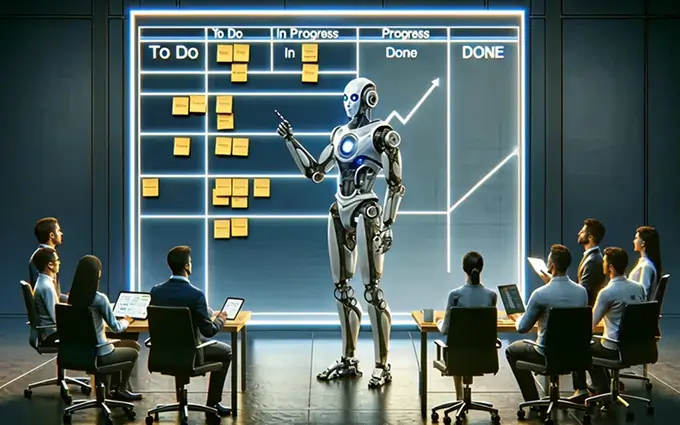
Unique Value Proposition
Design an agentic AI layer that assumes most day‑to‑day Scrum Master responsibilities coordinating ceremonies, curating backlogs, generating documentation, and maintaining live delivery dashboards—while humans focus on coaching, stakeholder alignment, and complex decision‑making. Recent work on agentic AI architectures and AI in project management shows that multi‑agent systems can already plan tasks, call tools, and coordinate workflows autonomously when given clear goals and guardrails.[1][2]
For Innopas and lalla.ai, this becomes a production-ready reference implementation of agentic AI for software engineering teams, directly aligned with the company’s focus on applied AI, governance, and measurable delivery outcomes.[3][4]
Core Capabilities
1. End‑to‑End Ceremony Orchestration
The agent connects to calendars, chat, and work‑tracking tools to own the full lifecycle of Agile ceremonies:
- Schedule and update sprint planning, daily stand‑ups, reviews, and retros based on team availability and time zones.
- Generate agendas tailored to current sprint context (open blockers, high‑risk items, stakeholder dependencies).
- Start meetings, capture key decisions and action items, and distribute summaries immediately afterward.
AI‑driven scheduling and stand‑up automation are already being used to shorten meetings and reduce coordination load in Agile teams, confirming feasibility and value of this capability.[5][6]
2. Backlog, Epics, and User Story Intelligence
Using LLMs and retrieval over product documents, tickets, and historical sprints, the agent can:
- Transform high‑level requirements or PRDs into structured epics, user stories, and acceptance criteria.
- Suggest story slicing when items are too large, using patterns learned from past work.
- Propose story point ranges based on historical effort for similar work.
- Maintain alignment between epics, stories, and business outcomes by automatically linking them to objectives and key results.
Research on language‑model‑based project planning shows that LLMs can reliably decompose goals into actionable tasks and plans when grounded in project context and supported by tool calls for validation.[7][8]
3. Autonomous Stand‑Ups and Blocker Detection
Instead of relying solely on manual updates, the agent continuously reads signals from tools and communication channels:
- Pre‑computes “yesterday/today/blockers” for each engineer from commits, merges, ticket transitions, and comments.
- Enables async stand‑ups in chat by posting a structured summary and prompting only for corrections or clarifications.
- Detects likely blockers early from stalled tickets, repeated re‑opens, and negative sentiment in chat messages, surfacing them with suggested owners and next actions.
Studies on AI‑supported agile practices and AI‑assisted stand‑ups note that combining tool telemetry and conversation analysis can highlight issues days earlier than human observation alone, improving sprint predictability.
4. Automated Documentation and Confluence Publishing
The agent acts as a continuous documentation engine:
- Generates sprint planning notes, stand‑up logs, review write‑ups, and retrospective summaries in Confluence‑compatible formats.
- Maintains a living “Sprint Hub” page with goals, scope, risks, decisions, and links to key artifacts.
- Drafts release notes from closed tickets and merged PRs, organized by user‑visible changes, technical improvements, and fixes.
LLMs have been shown to significantly reduce the documentation burden in software teams when applied to meeting transcripts, issue histories, and commit logs, while keeping content aligned with existing templates and structures.
5. Real‑Time Agile Delivery Dashboard
By fusing data from issue trackers, code repositories, and calendars, the agent continuously updates a delivery health dashboard:
- Burn‑down and burn‑up charts, cumulative flow, throughput, and cycle time.
- Sprint risk indicators (scope creep, rising work‑in‑progress, aging work items).
- Cross‑team dependency maps for scaled agile environments.
Prior work on AI in project management emphasizes that agentic systems are most useful when they not only automate tasks but also surface forward‑looking risk signals and recommendations based on historical patterns.
Why This Is Unique to Innopas + lalla.ai
Built as a Reference Agentic Pattern for Enterprises
The solution becomes a showcase implementation of the agentic AI design principles Innopas promotes: modular agents with narrow responsibilities, robust tool integrations, and strong human‑in‑the‑loop controls, rather than a monolithic chatbot. It can be reused as a blueprint for other domains (e.g., contact centers, operations, compliance workflows) where orchestration of multi‑step processes is needed.
Enterprise‑Grade Governance and Observability
Innopas’ focus on AI governance, auditability, and risk controls in BFSI and other regulated sectors can be directly embedded:
- Every AI action (rescheduling a ceremony, editing a ticket, changing a metric) is logged with reasoning and source data, enabling full audit trails.
- Policies limit what the agent can do autonomously vs. what requires human approval (e.g., changing sprint scope vs. updating Confluence text).
- Metrics dashboards track not just delivery outcomes but also the AI’s own accuracy and impact, aligning with modern guidance on safely deploying agentic systems in production.
Deep Integration into lalla.ai Applied AI Studio
Within the lalla.ai Studio, this use case can serve as a flagship “Applied AI for Software Delivery” accelerator:
- Preconfigured workflows and prompts for common agile tools (Jira, Azure DevOps, Confluence, GitHub, Slack/Teams) that clients can customize.
- Evaluation harnesses for measuring improvements in cycle time, sprint predictability, and team satisfaction before and after deployment, reinforcing the “measurable KPIs, not just tech metrics” positioning.
- A reusable orchestration layer that lets clients plug in their preferred foundation models or on‑prem LLMs while reusing the same agent behaviors.
Human‑Centered Agile, Not “Robotic Agile”
Current industry commentary stresses that the future of Scrum is AI‑augmented, not AI‑replaced: Scrum Masters shift to coaching, organizational change, and value maximization while AI handles orchestration and reporting. Positioning this solution explicitly as a co‑pilot that takes the busywork so humans can focus on people and outcomes aligns with agile values and differentiates Innopas from tool vendors pitching pure automation.